Modern story house built from scratchinto comfort and usability
Lorem ipsum dol amet consectetu adipiscing elit, seding doi eiusmod.



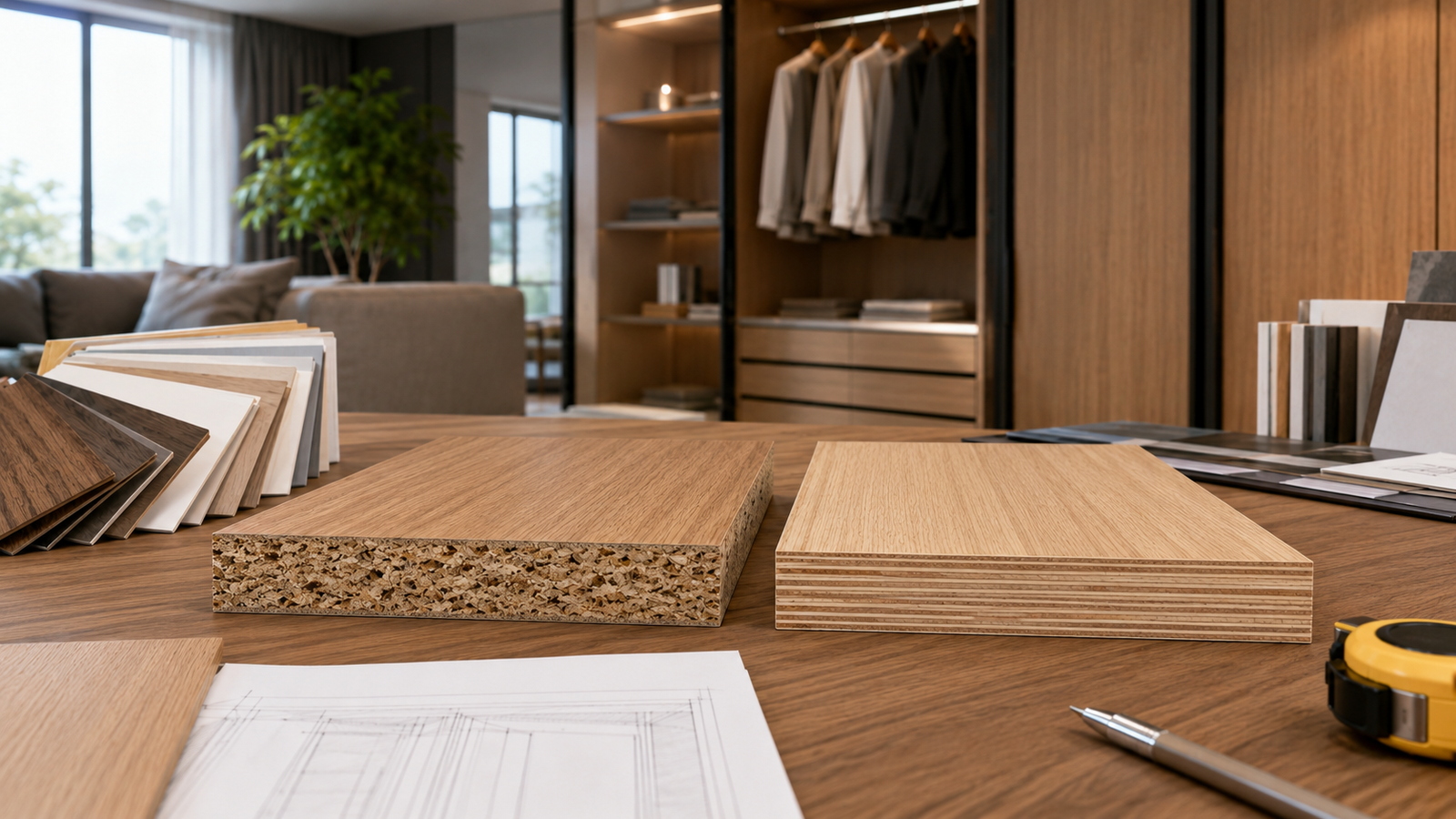
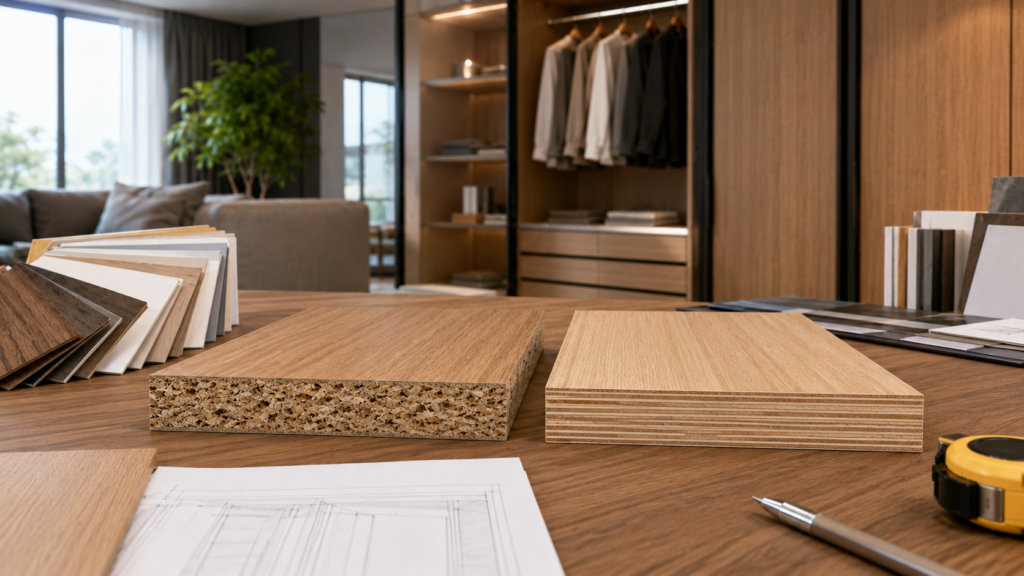
When planning whole-home custom interiors, material selection is one of the most important decisions behind the final look, cost, durability, and daily experience of the project. Many homeowners pay close attention to color, cabinet style, handle design, and layout, but the board material inside the furniture often determines how the cabinets perform after years of use. This is especially true for wardrobes, kitchen cabinets, living room storage, dining room cabinets, entryway systems, and multi-functional spaces.
For many custom furniture projects, two common options are particle board and multilayer board. In Chinese, these are often discussed as Particle Board vs Multilayer Board. Both materials are widely used in cabinetry and interior furniture, but they are not the same. Particle board is usually made from wood particles bonded with adhesive, while multilayer board is generally made from multiple layers of wood veneer pressed together. The U.S. EPA also classifies particleboard and hardwood plywood among regulated composite wood products, which means formaldehyde compliance and material certification are important factors when these materials are sold or imported into the United States.
For a whole-home customization company like NANHONGDINGYU, this comparison is not just about which board is “better.” It is about choosing the right material for the right space, budget, function, and lifestyle. The company’s website presents a full-service custom furniture process that includes layout planning, material selection, design development, manufacturing, and on-site installation, which makes material choice a key part of the overall project strategy.
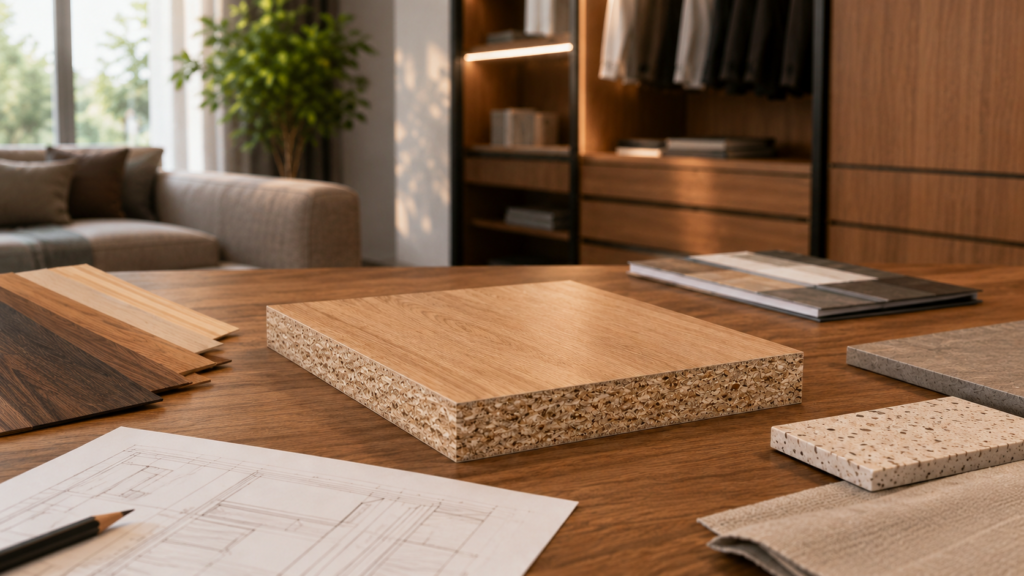
Particle board is an engineered wood panel made from wood chips, sawdust, and small wood particles bonded together with resin under heat and pressure. Because it uses smaller wood pieces, it can be produced with a smooth and consistent surface. This makes it popular for furniture panels, cabinet doors, shelves, wardrobe bodies, office furniture, and decorative interior panels.
In modern custom furniture, particle board is rarely used as a raw exposed board. It is usually finished with melamine, laminate, wood veneer, PET film, UV coating, or other decorative surface materials. These finishes help improve appearance, scratch resistance, and daily usability.
Particle board is popular because it offers a practical balance between cost, appearance, and manufacturing efficiency. It can be cut, drilled, edged, and finished with high consistency. For large projects, especially whole-home customization, this consistency matters. A wardrobe wall, TV cabinet system, kitchen storage area, and entryway cabinet may require dozens or even hundreds of panels. Particle board helps keep the surface color, thickness, and finish more uniform across the entire project.
Particle board is also cost-friendly. Compared with many types of plywood or solid wood, it usually helps reduce project cost while still providing a clean, modern appearance. For homeowners who want a polished custom look without overspending, particle board can be a smart option.
Particle board is often used in wardrobe cabinets, cabinet bodies, shelves, drawer panels, TV wall storage, office cabinets, children’s room storage, and decorative wall systems. It works especially well in dry indoor areas where the furniture is not constantly exposed to water or heavy impact.
In a bedroom wardrobe, for example, particle board can perform well because it mainly supports clothing, bedding, accessories, and light storage. In a living room cabinet, it can create a smooth, modern surface with excellent color consistency. In a study room, it can be used for bookshelves, desks, and wall storage, depending on the load requirements and hardware quality.
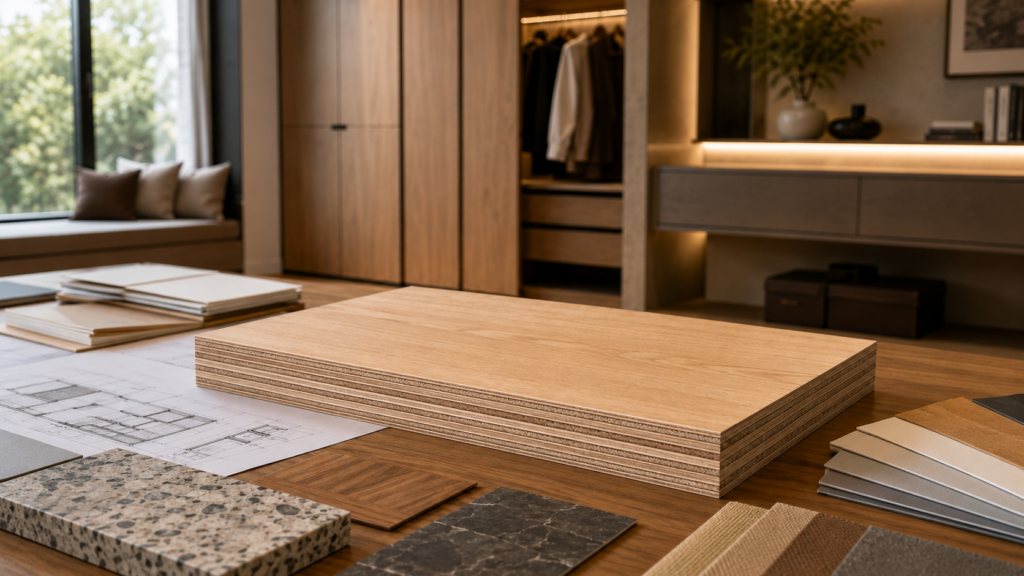
Multilayer board, often compared with plywood, is made from multiple thin wood veneers bonded together. The grain direction of each layer is usually arranged at alternating angles, which helps improve dimensional stability and strength. This cross-layer structure is one of the main reasons multilayer board is known for better screw-holding ability, stronger load-bearing capacity, and improved resistance to deformation.
Plywood and multilayer board are not always identical in every market, because naming can vary by region and manufacturer. However, in furniture discussions, “multilayer board” generally refers to a plywood-style panel made from stacked wood layers.
Multilayer board is often chosen when strength and structural stability are priorities. Its layered structure helps distribute stress across the panel. This makes it useful for cabinet bodies, shelves, kitchen cabinets, bathroom-adjacent storage, and areas where furniture may need to hold heavier items or handle frequent opening and closing.
Many homeowners prefer multilayer board because it feels more substantial and often provides better screw grip than standard particle board. This matters in cabinets with hinges, sliding rails, pull-out baskets, wall-mounted storage, or hardware that will be used every day.
Multilayer board is commonly used in kitchen cabinets, bathroom vanities, heavy-duty wardrobes, cabinet frames, structural furniture parts, shelves, tatami storage platforms, and custom furniture that needs greater support. It can also be used in areas where moisture risk is higher, although it is still important to choose the right surface finish, edge sealing, and installation method.
For example, a kitchen base cabinet may face steam, spills, cleaning, and heavy cookware. In this situation, multilayer board can offer better structural confidence than lower-grade particle board. For a large wardrobe with tall doors and frequent use, multilayer board may also improve long-term stability when paired with quality hardware.
The biggest difference is internal structure. Particle board is made from compressed wood particles. Multilayer board is made from stacked wood veneers.
This difference affects almost everything else: strength, screw holding, moisture performance, weight, cutting behavior, and cost. Particle board has a more uniform internal density, while multilayer board has a layered grain structure. The uniformity of particle board makes it good for smooth finishes. The layered structure of multilayer board gives it better mechanical strength in many furniture applications.
Multilayer board usually has stronger load-bearing ability than particle board. Because it is built with multiple wood layers, it can handle weight more effectively, especially when used for shelves, cabinet frames, or furniture that carries heavy objects.
Particle board can still be strong enough for many home furniture applications, especially when the design is reasonable. A properly supported particle board shelf in a wardrobe or TV cabinet can work well. However, if the shelf is too long, too thin, or overloaded, it may sag over time.
For large custom furniture projects, the material decision should match the function. A decorative cabinet does not need the same board strength as a kitchen base cabinet holding stone cookware, metal pans, or built-in appliances.
Screw-holding power is another major difference. Multilayer board usually performs better because screws bite into layered wood veneers. This makes it a strong option for hinges, drawer slides, wall-mounted brackets, and repeated hardware adjustments.
Particle board can hold screws well when the board is dense and the hardware is installed correctly. However, if screws are removed and reinstalled multiple times, particle board may lose grip more easily. This is why installation accuracy matters. Once a particle board panel is drilled incorrectly, repair can be harder than with multilayer board.
In custom interiors, this difference is important for moving parts. Doors, drawers, pull-out baskets, lift-up doors, and sliding systems all depend on secure hardware. A high-quality design team should consider not only the panel material but also hinge type, screw length, edge distance, and daily usage frequency.
Multilayer board generally offers better moisture resistance than standard particle board, especially when the board quality and adhesive are good. Its layered structure makes it less likely to swell dramatically from minor moisture exposure.
Particle board is more sensitive to water. If water enters through unfinished edges, screw holes, or damaged surfaces, the board may swell and lose strength. That does not mean particle board cannot be used in home furniture. It simply means it needs good edge banding, careful installation, and proper placement away from wet zones.
In kitchens, bathrooms, balconies, and laundry areas, moisture risk should be taken seriously. Even the best board can fail if water sits on unsealed edges for a long time. Good design should include sealed edges, raised cabinet bases, quality countertops, proper ventilation, and smart layout planning.
Particle board often provides excellent surface flatness. This makes it a strong choice for modern cabinet doors and decorative panels with melamine, laminate, or other flat finishes. When a project needs large, clean, consistent surfaces, particle board can deliver a refined look.
Multilayer board can also be finished beautifully, but the surface quality depends on the face veneer and production quality. Some lower-grade multilayer boards may have surface unevenness, gaps, or internal voids. For premium cabinet appearance, both materials need proper grading, finishing, and processing.
Multilayer board is often heavier than particle board, depending on wood species, thickness, and density. Heavier panels can provide a more solid feel, but they may also increase transportation difficulty, installation labor, and hardware stress.
Particle board can be easier to process in large quantities and may help reduce installation complexity. For wall-mounted cabinets, weight becomes especially important. A lighter panel can reduce stress on the wall, but the final decision must consider cabinet size, wall structure, anchors, and safety requirements.
Particle board is usually more affordable than multilayer board. This is one of its biggest advantages. For homeowners working with a controlled budget, particle board can make whole-home customization more accessible.
Multilayer board usually costs more because of its veneer structure, production process, and stronger performance. The higher cost can be worthwhile in areas where durability, moisture resistance, and structural support matter most.
A smart project does not always choose the most expensive material everywhere. Instead, it assigns materials strategically. For example, a home may use multilayer board in the kitchen and bathroom-adjacent storage, while using particle board in dry wardrobes, decorative cabinets, and living room storage. This approach can balance performance and budget.
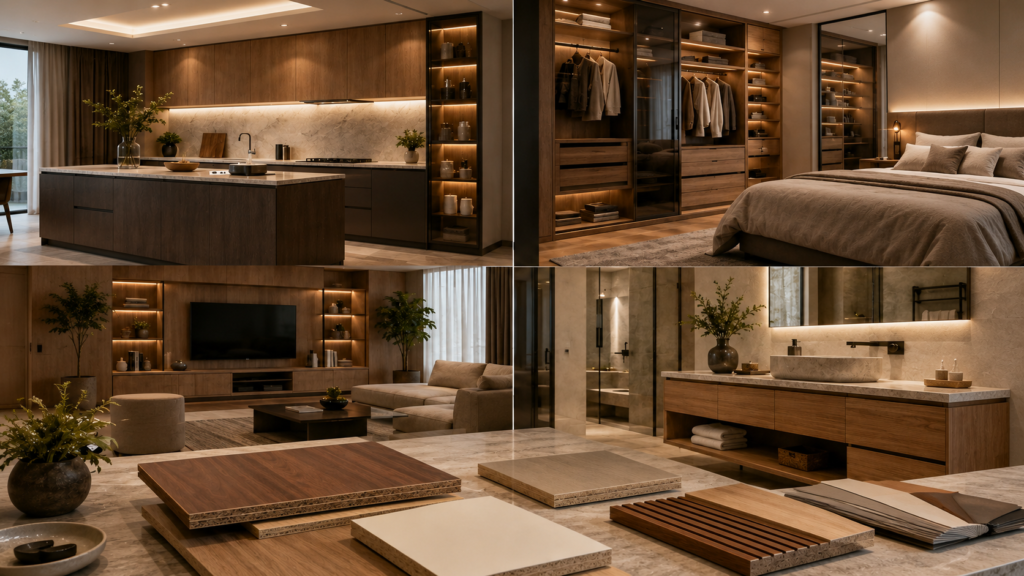
For kitchens, multilayer board is often the safer and more durable choice, especially for base cabinets. Kitchens face moisture, heat, oil, cleaning, and heavy storage. The cabinet body may need to support cookware, tableware, pull-out baskets, sinks, and countertops.
Particle board can still be used in some kitchen systems if it is high density, well sealed, and properly finished. However, if the kitchen is used heavily or the homeowner wants stronger long-term performance, multilayer board is usually a better investment.
Multilayer board is generally better for kitchen cabinet bodies, sink areas, and heavy-use zones. Particle board may be considered for selected upper cabinets or decorative panels when moisture exposure is limited.
Wardrobes are usually located in dry spaces, so particle board can work very well. It provides good surface consistency, attractive finishes, and reasonable cost. For large bedroom projects, particle board can help create a clean, unified look without pushing the budget too high.
Multilayer board is still a strong option for wardrobes, especially for tall cabinets, heavy doors, large sliding systems, or premium projects. If the wardrobe includes heavy storage, hidden beds, large drawers, or complex hardware, multilayer board may provide extra confidence.
Particle board is practical for standard wardrobes. Multilayer board is better for heavy-duty wardrobes, premium builds, or designs with frequent hardware use.
Living room cabinets often focus on visual impact. TV walls, display cabinets, bookshelves, and hidden storage need good design, clean lines, and stable finishes. Particle board is commonly used here because it creates smooth surfaces and consistent color.
However, if the cabinet includes long floating shelves, wall-mounted storage, or large display areas for heavy objects, multilayer board may be better for the structural parts. A mixed-material approach can work very well.
Particle board is suitable for decorative cabinets and standard storage. Multilayer board is better for long shelves, wall-mounted cabinets, and heavier display areas.
Entryway cabinets handle shoes, bags, keys, cleaning tools, and everyday movement. They may also face moisture from wet shoes or umbrellas. For this reason, material selection depends on how the entryway is used.
Particle board can work for dry entryways with good ventilation. Multilayer board is better when the cabinet base may contact moisture or when the design includes seating, heavy storage, or tall vertical structures.
Use particle board for standard dry storage. Use multilayer board for cabinet bases, bench structures, and areas exposed to moisture.
Bathrooms are high-moisture environments. Even when a cabinet is not directly inside the shower area, humidity can affect panels over time. For bathroom vanities or bathroom-adjacent cabinets, multilayer board is generally a better choice than standard particle board.
That said, the board alone is not enough. The finish, edge sealing, countertop protection, ventilation, and installation details all matter. A poorly sealed multilayer board can still fail, while a well-protected board can last much longer.
Multilayer board is usually better. Waterproof surface finishing and excellent edge sealing are essential.
Both particle board and multilayer board can involve adhesives. This is why formaldehyde emission standards matter. In the United States, composite wood products such as particleboard, medium-density fiberboard, and hardwood plywood must meet TSCA Title VI labeling and certification requirements when sold, supplied, manufactured, or imported after the applicable compliance dates.
For homeowners, this means the question should not only be “particle board or multilayer board?” It should also be “Is the board compliant, certified, and suitable for indoor furniture?” A lower-quality board with poor emissions control can create concerns, regardless of whether it is particle board or multilayer board.
When choosing custom furniture, customers should ask about material grade, environmental rating, surface finish, edge banding, and supplier documentation. Good custom furniture providers should be able to explain these details clearly.
A reliable company should also help customers understand where each material is used and why. This is part of professional material planning, not just sales. NANHONGDINGYU’s service model includes material selection and design development as part of its whole-home customization process, which supports a more informed and organized project experience.
The first step is to look at the room. Is it dry or humid? Is it a bedroom, kitchen, bathroom, living room, or entryway? Dry rooms allow more flexibility. Wet or heavy-use areas require stronger material planning.
Next, consider how the furniture will be used. A guest room wardrobe may not need the same material as a family kitchen. A decorative cabinet may not need the same strength as a full-height storage wall. A shoe cabinet used daily by a large family may need better durability than a rarely used hallway unit.
Hardware can change the material decision. If the cabinet includes many hinges, drawer slides, pull-out trays, lift systems, or sliding doors, screw-holding power becomes more important. In these cases, multilayer board may be worth the extra cost.
A higher budget does not mean every panel must be multilayer board. A lower budget does not mean the project must sacrifice quality. The best solution often combines materials. Use stronger boards where performance matters and cost-efficient boards where they are fully suitable.
Many board problems begin at the edges. Water, steam, and daily wear often enter through poorly sealed edges. Good edge banding can improve the performance of both particle board and multilayer board. In custom furniture, edge treatment is just as important as the board itself.
This is not true. High-quality particle board is widely used in modern furniture and can perform very well in dry indoor spaces. It offers smooth surfaces, stable appearance, and strong cost control. The key is to use it in the right place with proper finishing.
Multilayer board is stronger in many ways, but it is not always necessary. It costs more and may be heavier. For large decorative surfaces or budget-sensitive projects, particle board may be more practical.
Board material is important, but it is only one part of the system. Design accuracy, hardware quality, edge sealing, installation skill, ventilation, and after-sales support all affect the final result. NANHONGDINGYU highlights a structured workflow from consultation and measurement to design, production, delivery, installation, and after-sales support, which is exactly the kind of process that helps material decisions become practical results.
For most homes, the best answer is not to choose one material for everything. Instead, use each material where it performs best.
Use particle board for dry wardrobes, decorative living room cabinets, study room storage, and cost-controlled custom furniture. It offers a clean finish, strong design flexibility, and good value.
Use multilayer board for kitchens, bathroom-adjacent cabinets, heavy-duty shelves, entryway bases, wall-mounted structures, and furniture with frequent hardware movement. It provides better strength, screw holding, and moisture tolerance.
This balanced approach helps homeowners control cost while improving durability in the areas that need it most. It also reflects how professional whole-home customization should work: every decision should connect to lifestyle, space planning, material performance, production quality, and long-term maintenance.
The debate of particle board vs multilayer board is not about choosing a single winner. Particle board is affordable, smooth, consistent, and suitable for many dry interior furniture applications. Multilayer board is stronger, more durable, and better suited for kitchens, humid areas, heavy storage, and hardware-intensive cabinets.
For whole-home custom interiors, the smartest choice is based on room function, moisture exposure, load requirements, hardware use, budget, and desired finish. A professional company like NANHONGDINGYU can help homeowners compare materials, plan cabinet structures, preview designs, manage production, and complete installation with a more organized process. When the right board is used in the right place, custom furniture can look better, last longer, and support everyday living with more confidence.
Particle board is made from compressed wood particles, chips, and resin, while multilayer board is made from multiple layers of wood veneer pressed together. Particle board is usually more affordable and suitable for dry indoor furniture. Multilayer board is generally stronger, more stable, and better for areas that need higher durability.
Yes, particle board can be a good choice for custom furniture, especially wardrobes, TV cabinets, study room storage, and decorative cabinets in dry spaces. It offers a smooth surface, consistent finish, and good cost control. However, it should be properly sealed and protected from moisture.
Multilayer board is usually better in strength, screw-holding power, and moisture resistance. It is often recommended for kitchens, bathroom-adjacent cabinets, heavy-duty shelves, and high-use furniture. However, particle board may still be the better choice when budget, surface consistency, and dry-space use are the main priorities.
Multilayer board is usually the better option for kitchen cabinets because kitchens face moisture, heat, cleaning, and heavy daily use. It provides better structural support and stronger screw-holding ability. Particle board can be used in some kitchen areas, but it requires high-quality edge sealing and moisture protection.
For standard bedroom wardrobes, particle board is often practical and cost-effective. It provides a clean appearance and works well in dry indoor spaces. For large wardrobes, heavy doors, premium storage systems, or frequent-use hardware, multilayer board may offer better long-term stability.
Homeowners should choose based on the room, moisture level, storage weight, hardware use, budget, and desired finish. Particle board works well for dry, decorative, and budget-friendly furniture. Multilayer board is better for kitchens, bathrooms, entryways, heavy storage, and cabinets that need stronger durability.
 03Jul
03Jul
 04Jul
04Jul
 by
by