Hotel projects live or die on two things: the guest room looks exactly like the render, and it opens on the date the owner promised. Furniture sits at the intersection of both — it is the largest single line item in FF&E, it is custom, and it arrives last before opening. This guide explains how hotel contractors, purchasing bureaus and interior designers source custom furniture from China without losing control of quality, budget or schedule.
Why hotel projects source furniture from China
Three reasons, in order of importance: custom capability, cost structure and production depth.
- Custom capability. Guest room casegoods are not catalogue products. A 1,200-room project needs wardrobes, vanities, headboards and minibar units built to drawings, with the same finish across every unit. Chinese contract factories are set up for exactly this: small design teams, flexible tooling and high-volume repeat production.
- Cost structure. Factory-direct pricing removes the importer margin and the regional distributor layer. For a project of 100+ rooms the difference is usually the difference between making the budget and missing it.
- Production depth. A single factory that handles panels, edge banding, solid wood, lacquer, upholstery, stone tops and packing keeps the finish consistent. Splitting a project across five suppliers is how you get five slightly different whites.
The sourcing process, step by step
1. Send drawings, not photos
Shop drawings or a full FF&E schedule with dimensions, materials, finishes and hardware specification. A photo of a reference room is useful context, not a production document. The clearer the drawing package, the fewer revision loops later.
2. Fix the material standard before pricing
Decide the panel core (multi-layer plywood vs particle board vs OSB), the edge banding method (PUR vs laser), the hardware brand tier and the finish system (lacquer, veneer, melamine, stone). Price follows material, never the other way round.
3. Prototype or mock-up room
For serial projects, build one room first. A mock-up room is cheap insurance: it surfaces every interface issue — wall panels against casegoods, door swing, plumbing position for vanities — before you commit to 200 units.
4. Agree the inspection standard in writing
Define what “acceptable” means: panel thickness tolerance, edge banding glue line width, colour delta against the approved sample, moisture content, hardware function, packing method. Put it in the contract, not in emails.
5. Production and in-line QC
Ask for dated photos at three points: after panel cutting, after assembly, after finishing. Factories that resist this are factories you should not use.
6. Packing for export
Hotel furniture travels by sea and gets handled four times before it reaches the room. Wooden crate packing with foam corner protection, edge guards and moisture barrier is standard for contract work — cartons alone are not enough for vanities and tall units.
Quality checkpoints that actually matter
- Panel core. Multi-layer plywood holds screws and resists warping better than particle board in humid climates; OSB is stable but heavier. Ask which core is quoted — “18mm board” tells you nothing.
- Edge banding. Laser edge banding gives a seamless line but needs precise panel calibration. PUR gives a stronger bond and better water resistance. For hotel bathrooms, PUR or laser, not thin PVC.
- Moisture content. Kiln-dried timber to 8-12% prevents the cracks and gaps that appear six months after opening.
- Hardware. Soft-close hinges and drawer runners from a known brand cost little per unit and decide how the room feels to a guest.
- Finish consistency. Colour-match against an approved physical sample under the same light source, batch by batch.
Certification and compliance by market
Compliance is the part most first-time buyers underestimate, and it is usually what stops a container at the port.
- Saudi Arabia: SASO certification through the SABER platform is required for clearance. Furniture safety and fire performance standards apply, and the certificate must be issued before shipment.
- UAE and GCC: requirements vary by emirate and by project specification; civil defence fire requirements are common on hotel work.
- European Union: CE marking where applicable, plus formaldehyde emission limits for wood-based panels.
- North America: CARB / TSCA Title VI for composite wood, and ENF-grade boards where the specification calls for it.
- All markets: ISPM 15 heat treatment for wood packing material — a stamped crate, not a promise.
A factory that has shipped to your market before will already know these steps. Ask for the last three shipments to your country and the certificates that went with them.
Five mistakes that cost hotel projects money
- Buying on price before material. Two quotes 40% apart are almost never the same product.
- No mock-up room. The cheapest place to fix an interface problem is a sample room, not a finished floor.
- Loose tolerances. “Standard export quality” means nothing in a contract.
- Packing as an afterthought. Damage in transit is the most common hidden cost.
- Ignoring the certificate timeline. Certification runs in weeks, not days; start it when you place the order.
What we do at Nanhong Dingyu
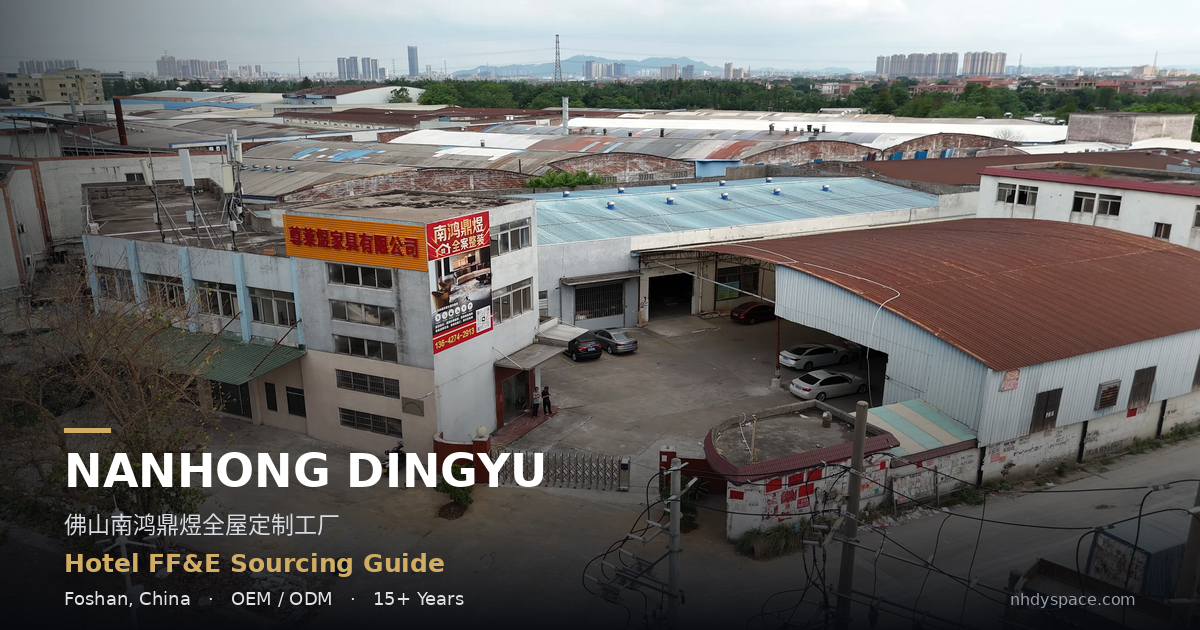
We are a custom furniture factory in Foshan, China, with more than 15 years of experience supplying hotels, private clubs, serviced apartments and whole-home projects. Our work covers guest room casegoods, lobby and restaurant furniture, built-in cabinetry, wall panels, rattan doors and stone tops — engineered to your drawings, produced to your material standard, and packed in wooden crates for export.
We work directly with contractors, purchasing bureaus and design studios: send us an FF&E schedule or drawing package and we will return a package-by-package quotation, a production schedule and references from comparable projects.
WhatsApp: +86 139 2858 5024
Email: [email protected]
Factory video: take a 30-second look inside our workshop
Frequently asked questions
What is a typical minimum order for hotel furniture?
For serial guest room furniture, most contract factories quote from one room set upward; project pricing usually starts to make sense from 30-50 rooms. Custom lobby or restaurant pieces are quoted per item.
How long does production take?
Typically 30-45 days after drawing approval and sample sign-off, plus 25-40 days sea freight depending on destination. Certification work runs in parallel.
Can you supply to a design specification from our interior designer?
Yes. Send the drawings, the finish schedule and the approved material samples; we build to specification and return shop drawings for approval before production.
Do you handle export packing and shipping documents?
Yes — wooden crate packing, marking, packing lists and the documents required for customs clearance, coordinated with your forwarder or ours.



 04Nov
 by