Modern story house built from scratchinto comfort and usability
Lorem ipsum dol amet consectetu adipiscing elit, seding doi eiusmod.


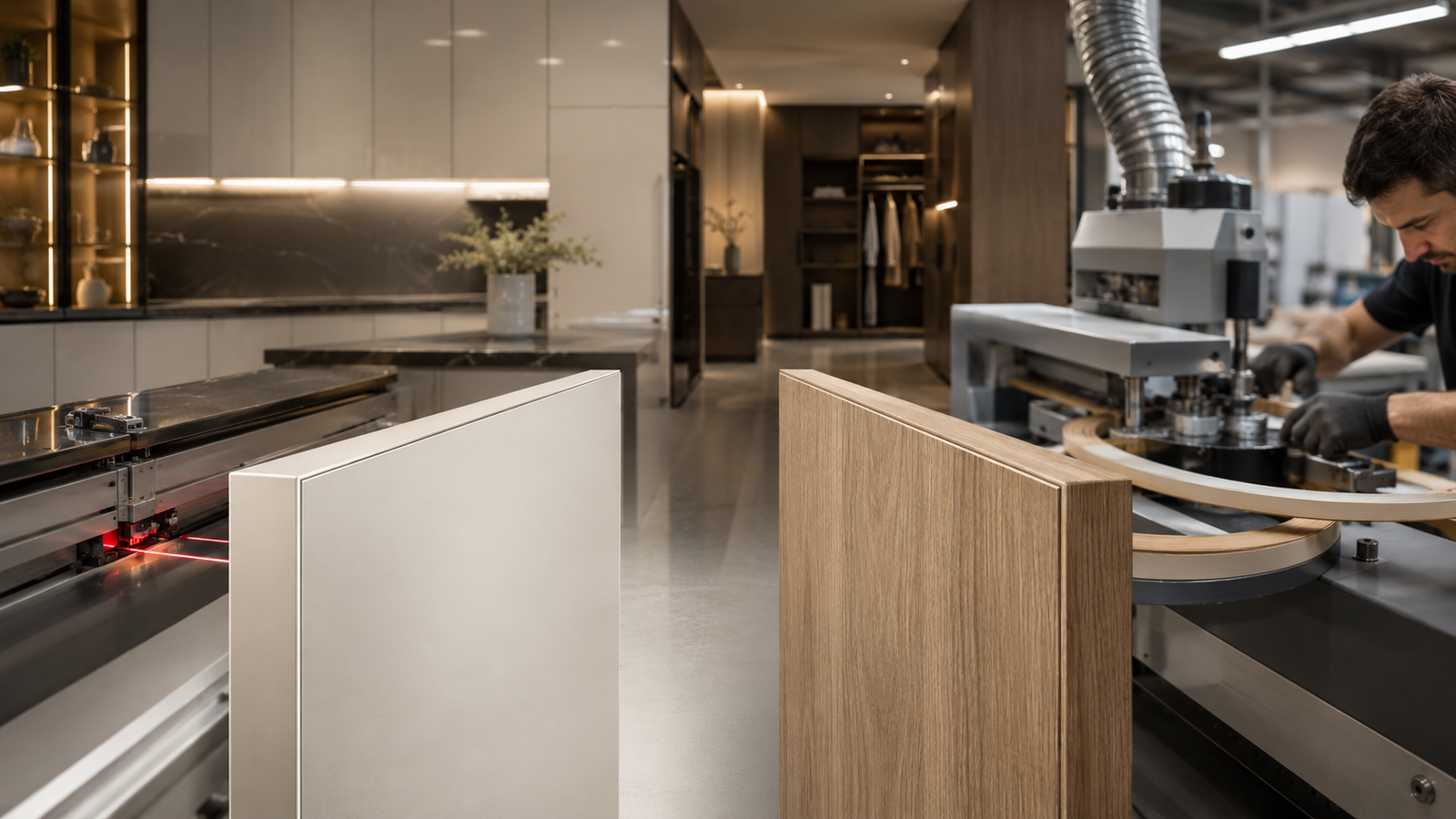
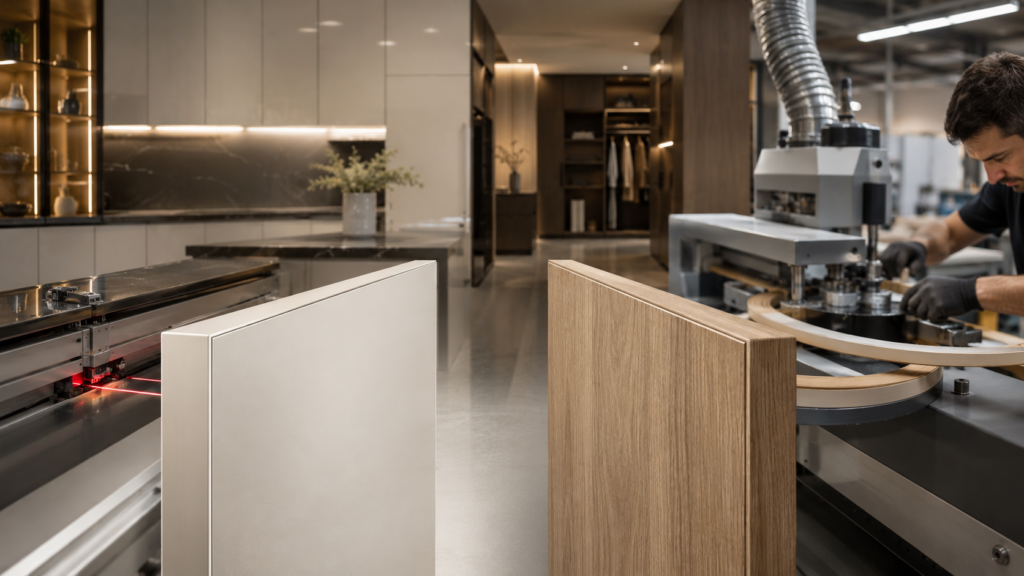
In whole-home customization, small details often decide whether a cabinet feels ordinary or truly premium. Door panels, drawer fronts, wardrobes, kitchen cabinets, entryway storage, and bathroom vanities may look simple from a distance, but their long-term quality depends on how every edge is finished. Edge banding protects the raw panel core, improves visual continuity, reduces moisture exposure, and gives custom cabinetry a clean, finished look.
For homeowners, designers, and renovation clients, two terms are becoming more common in premium cabinetry discussions: laser edge banding and PUR edge banding. Both are more advanced than traditional EVA hot-melt edge banding, and both can create a cleaner, stronger, more refined result. However, they are not the same.
Laser edge banding is often known for its “zero-joint” appearance. PUR edge banding is known for its strong adhesive performance, moisture resistance, and practical reliability in kitchens, bathrooms, and daily-use storage areas. The better choice depends on your budget, material selection, design expectations, production standards, and the specific space being customized.
At NANHONGDINGYU, whole-home customization is not only about appearance. The process includes layout planning, material selection, design development, manufacturing, installation, and after-sales support. According to the Nanhong Dingyi website, the company provides whole-home custom furniture solutions and supports clients through measurement, planning, 3D visualization, production, delivery, installation, and after-sales service.
This article explains the real difference between laser edge banding and PUR edge banding, how each process works, where each one performs best, and how to choose the right option for modern custom interiors.
Edge banding is the process of applying a narrow strip of material to the exposed edges of furniture panels. These panels are often made from engineered boards such as particleboard, MDF, plywood, or multi-layer boards. Without edge banding, the panel core would remain visible and vulnerable.
A well-finished edge does several important things. It covers the raw board core, improves the appearance of the cabinet, protects the panel from moisture and wear, reduces chipping, and helps the entire piece look more refined. Industry sources also describe edge banding as a protective finishing step that helps prevent chipping, moisture exposure, and delamination while creating a more professional cabinet appearance.
In a kitchen, for example, cabinet doors are opened many times a day. The edges may be exposed to steam, cleaning products, hand contact, and small impacts. In a wardrobe, edge quality affects how seamless the doors look across a large surface. In a bathroom vanity, moisture resistance becomes even more important. That is why edge banding should not be treated as a minor production detail.
In modern interior design, minimalism is popular. Many homeowners prefer flat cabinet doors, large wall-to-wall storage systems, handleless designs, hidden storage, and clean vertical lines. In these designs, every visible joint becomes more noticeable. A thick glue line, uneven edge, or mismatched banding color can weaken the entire design.
This is where laser and PUR edge banding stand out. They both aim to create cleaner edges than traditional hot-melt methods, but they do it in different ways.
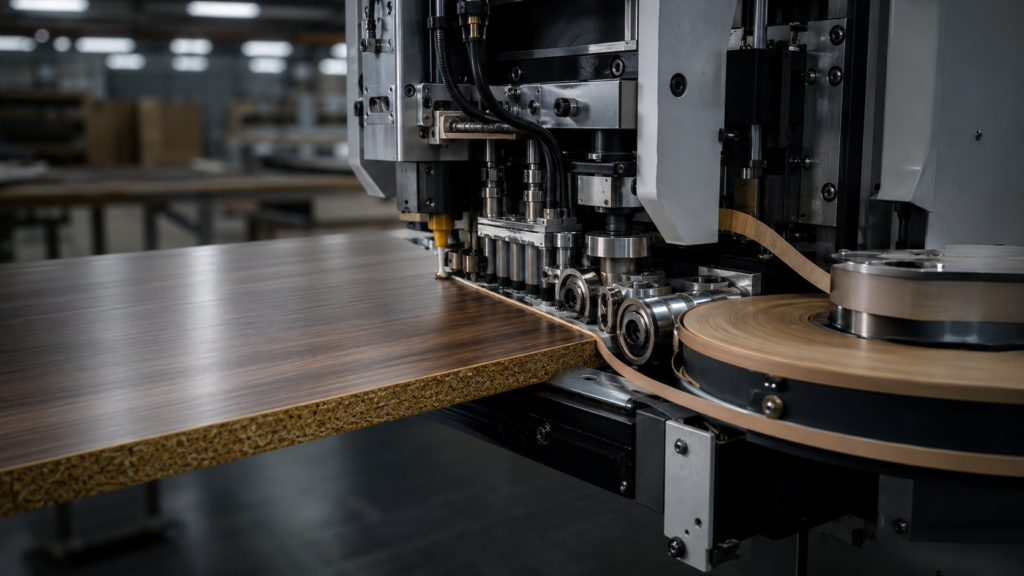
PUR stands for polyurethane reactive adhesive. In PUR edge banding, a reactive polyurethane adhesive is applied between the panel and the edge banding strip. After application, the adhesive cures through a chemical reaction with moisture in the air or material. Once cured, the bond becomes strong, durable, and more resistant to heat and moisture than standard EVA hot-melt glue.
In a PUR edge banding process, the panel moves through an edge banding machine. The adhesive is heated and applied in a controlled layer. The edge banding strip is then pressed firmly against the panel edge. Over time, the PUR adhesive completes its curing process and forms a stable bond.
Unlike EVA glue, which can soften again under heat, PUR develops a stronger chemical bond after curing. Several industry sources note that PUR provides better heat, humidity, water, and solvent resistance than EVA and can create a thinner, cleaner glue line.
PUR edge banding is widely used because it balances quality, durability, and production practicality. It does not require the same level of specialized edge banding material as laser edge banding, and it works with many panel and edge banding types.
Moisture resistance is one of PUR’s biggest advantages. Kitchens, bathrooms, laundry areas, and humid regions all place extra stress on cabinet edges. PUR adhesive forms a dense cured bond that helps reduce the risk of edge lifting, swelling, and moisture penetration. Industry references commonly describe PUR as suitable for kitchens and bathrooms because of its resistance to heat, moisture, and cleaning products.
Cabinets near ovens, dishwashers, cooktops, and sunny windows can experience temperature changes. PUR performs better than ordinary hot-melt adhesives in these conditions because the cured bond is less likely to soften from heat.
PUR does still use adhesive, so it does not create a true glue-free joint. However, the glue line is usually much thinner and cleaner than standard EVA edge banding. For many residential projects, especially matte finishes, wood tones, textured panels, and neutral cabinetry, the PUR result can look very premium.
PUR edge banding often offers a strong balance between premium quality and manageable cost. It is not the cheapest method, but it is usually more accessible than laser edge banding. For many whole-home customization projects, PUR delivers enough durability and visual quality without pushing the budget too high.
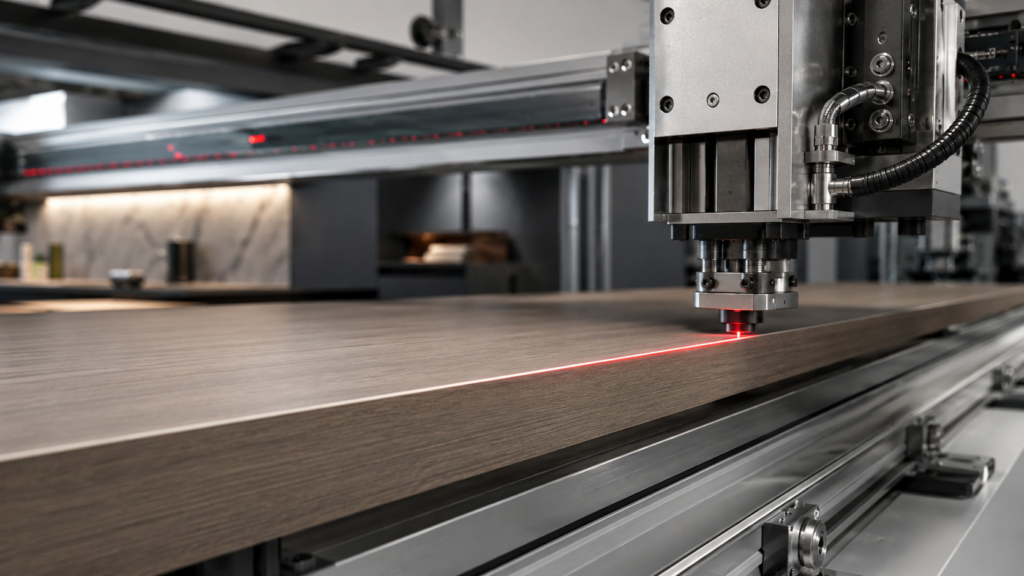
Laser edge banding is a more advanced edge finishing process that uses laser energy to activate a special functional layer on the back of the edge banding strip. Instead of applying traditional glue between the panel and the banding, the laser melts or activates the functional layer, which then bonds to the panel under pressure.
Laser edge banding requires compatible edge banding material. The edge strip usually has a functional backing layer designed to react to laser energy. During production, the laser heats this layer, and the strip is pressed onto the panel edge. As it cools, the edge bonds to the board.
Because there is no visible traditional glue layer, laser edge banding can produce what is often called a zero-joint or seamless edge effect. Industry sources describe laser edge banding as a process that creates an almost invisible transition between the board surface and the edge, especially compared with adhesive-based methods.
Laser edge banding is often chosen for high-end cabinetry, premium modern interiors, luxury wardrobes, high-gloss panels, acrylic panels, and designs where every visible detail matters.
The biggest advantage is the visual effect. Laser edge banding can create a very clean, almost invisible joint. On light-colored panels, glossy surfaces, acrylic finishes, and minimalist cabinetry, this seamless appearance can make the cabinet look more refined and integrated.
Since laser edge banding does not rely on a conventional glue layer, it avoids some common glue-line issues, such as discoloration, visible adhesive marks, or uneven glue spread. This is especially valuable for white, cream, beige, gray, and high-gloss cabinet designs.
For clients who want a luxury look, laser edge banding can support a higher-end design story. When used correctly, it can make large cabinet surfaces look more continuous and elegant.
Laser technology may also reduce some adhesive-related production concerns because it does not require traditional glue application in the same way. Some manufacturers describe laser edge banding as efficient and clean because it reduces adhesive consumables and produces smooth, precise edges.
Both methods can produce excellent results, but they serve different priorities. The comparison should not be simplified into “laser is always better” or “PUR is always more practical.” The right answer depends on the project.
Laser edge banding usually wins in pure visual seamlessness. It can create a zero-joint look that is difficult for adhesive-based systems to match. This matters most on high-gloss, acrylic, white, or ultra-minimal cabinet designs.
PUR edge banding also looks clean, especially when done with quality machinery, proper glue control, and well-matched banding. However, because it uses adhesive, a microscopic glue line may still exist. For many matte, textured, or wood-grain panels, this difference may be hard to notice in daily use.
Both technologies can be durable when properly manufactured. PUR is especially respected for its strong cured bond and resistance to heat and moisture. Laser edge banding can also perform very well, but the result depends heavily on material compatibility, machine settings, and production precision.
For practical residential use, PUR is often a strong choice for kitchens, bathrooms, laundry storage, and other high-use areas. Laser is excellent when the design requires the cleanest possible surface transition.
PUR performs extremely well in moisture-related conditions because the cured polyurethane bond creates a strong seal. This makes it highly suitable for kitchen cabinets, bathroom vanities, and humid spaces.
Laser edge banding can also provide strong sealing performance, but quality depends on the activated edge material and how well the machine bonds the strip to the panel. A high-quality laser process can be excellent, but a poorly controlled process may not deliver the expected premium result.
PUR is flexible in material compatibility. It can work with many types of edge banding and panel materials, including PVC, ABS, veneer, and various decorative surfaces.
Laser edge banding requires special laser-compatible edge banding material. This can limit choices or increase material cost. For some colors, textures, or custom finishes, PUR may be easier to apply consistently.
Laser edge banding generally requires more expensive equipment and compatible edge materials. This can increase the final project cost. PUR equipment and materials are also more advanced than traditional systems, but the overall cost is often more practical for whole-home customization.
For homeowners, this means laser may be best reserved for visible, design-critical areas, while PUR can be used across larger cabinetry systems for strong performance and better cost control.
Laser edge banding has high production requirements. The machine, edge material, panel preparation, pressure, speed, and temperature control must all be accurate. When everything is done well, the result can be beautiful. When production is not controlled properly, the “laser” label alone does not guarantee superior quality.
PUR also requires professional production control. Glue temperature, application amount, pressing pressure, and curing conditions matter. However, PUR is often more forgiving and practical for a wide range of custom furniture projects.
PUR forms a strong bond after curing, which is great for durability but can make rework more difficult. Laser edge banding can also be difficult to repair cleanly because the process depends on specialized equipment and materials.
For both methods, quality control before delivery is important. At NANHONGDINGYU, the website emphasizes a structured workflow from consultation and measurement to design development, production, quality check, delivery, installation, and after-sales support. This type of process is important because premium edge banding should be checked before the product reaches the home.
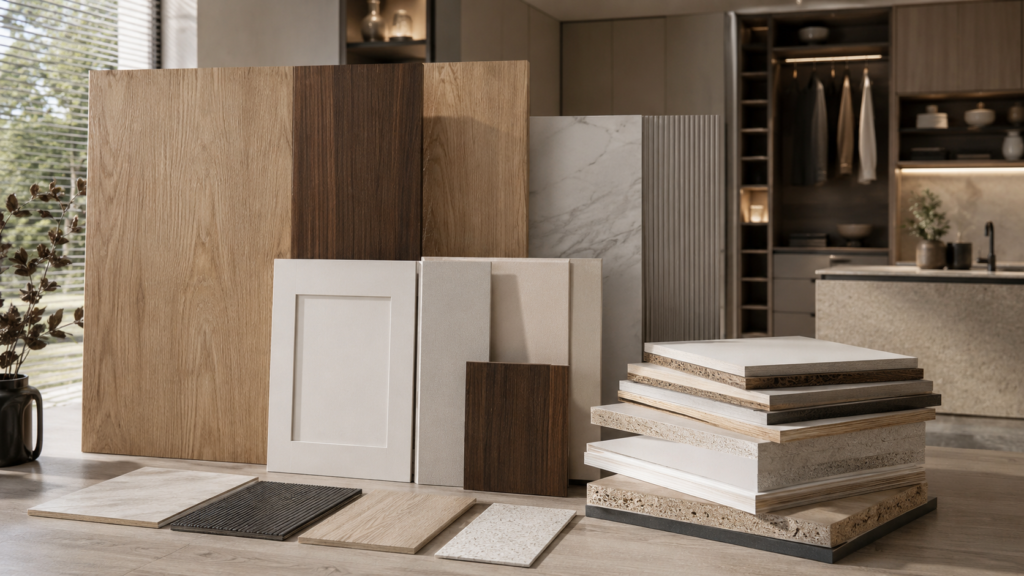
Kitchens are high-use spaces. Cabinet doors and drawers are opened daily. Edges may face steam, heat, cooking residue, and cleaning products. For this reason, the best kitchen edge banding should combine appearance, moisture resistance, and long-term adhesion.
PUR is often an excellent kitchen choice because of its moisture and heat resistance. It offers a strong bond and performs well in real-life conditions. For most kitchen cabinets, especially matte finishes, wood textures, neutral panels, and practical family homes, PUR provides a strong balance of durability and value.
Laser edge banding can be ideal for high-end kitchen designs where visual seamlessness is the main priority. For example, a handleless white kitchen with glossy or acrylic doors can benefit from the zero-joint look. The surface appears cleaner, more continuous, and more refined.
For most homeowners, PUR is the more practical all-around kitchen solution. For luxury visible doors, island fronts, or high-gloss feature panels, laser edge banding can be used selectively to enhance the premium look.
Wardrobes usually have large vertical surfaces. Because these doors are highly visible, edge appearance matters. However, wardrobes are usually not exposed to as much heat or moisture as kitchens and bathrooms.
Laser edge banding can be a strong choice for large wardrobe doors, especially in modern bedrooms where the design uses flat panels, hidden handles, or wall-to-wall storage. The seamless edge can make the entire wardrobe look more architectural.
PUR is also excellent for wardrobes. It provides clean edges, strong bonding, and reliable performance. For wood-grain panels, textured finishes, and standard matte surfaces, PUR may look nearly as refined as laser while keeping the project more cost-effective.
Choose laser if the wardrobe is a major visual feature and the design demands a seamless premium finish. Choose PUR if you want durability, good appearance, and better budget control.
Bathrooms are moisture-heavy spaces. Humidity, water droplets, cleaning products, and temperature changes can all affect cabinetry.
PUR’s moisture resistance makes it highly suitable for bathroom vanities and storage cabinets. Its cured bond can help reduce the risk of edge lifting and moisture-related failure. Since bathroom furniture is often exposed to more humidity than bedroom or living room cabinetry, adhesive strength and sealing performance matter more than a purely seamless visual effect.
Laser can work well in bathroom cabinetry if the materials, production process, and panel core are all suitable for humid environments. However, homeowners should not choose laser only because it sounds more advanced. The entire cabinet system must be moisture-conscious, including the panel, hardware, wall conditions, ventilation, and installation details.
For bathroom vanities and humid storage areas, PUR is often the most practical recommendation. It offers the moisture resistance and durability that these spaces need.
Whole-home customization is about consistency. A home may include kitchen cabinets, wardrobes, entryway shoe cabinets, TV walls, dining storage, study desks, bathroom vanities, balcony cabinets, and multi-functional storage systems. If each area uses a different quality standard, the home can feel inconsistent.
Edge banding affects how clean the cabinetry looks across the entire home. When edges are neat, thin, and color-matched, the furniture looks more unified. This is especially important in open-plan homes where kitchen, dining, and living areas are visually connected.
Good edge banding also protects the furniture over time. Poor edge sealing may lead to peeling, swelling, or rough edges. In contrast, high-quality PUR or laser edge banding supports a longer-lasting cabinet system.
When a client understands the difference between laser and PUR, they can make a more informed decision. Instead of choosing based only on marketing terms, they can match the technology to the room, material, budget, and lifestyle.
This fits the service logic of NANHONGDINGYU: clear planning, material selection, production, installation, and after-sales support. The company’s website also notes a “Preview First, Produce Later” philosophy, with 3D renderings, CAD drawings, and material samples before factory production. That kind of process helps clients confirm not only the layout and color, but also production details such as edge finishing.
Laser edge banding is visually impressive, but it is not automatically the best choice for every project. If the material is not laser-compatible, the production process is poorly controlled, or the space needs stronger practical moisture performance, PUR may be the better option.
PUR should not be confused with basic EVA edge banding. A high-quality PUR process can create a very thin, clean glue line and strong long-term performance. In many real homes, PUR looks premium and performs extremely well.
Edge banding affects both appearance and durability. It protects the panel core, reduces exposure to moisture, and helps the furniture withstand daily use. A beautiful cabinet with poor edge sealing may age quickly.
Execution matters more than the label. A well-made PUR edge can outperform a poorly made laser edge. A high-quality laser edge can look stunning when the right material and machine settings are used. Homeowners should ask about the full production standard, not just the name of the technology.
You want the cleanest possible zero-joint appearance. You are using high-gloss, acrylic, white, or minimalist panels. The cabinetry is highly visible. You are building a premium kitchen, wardrobe, or feature storage wall. Your budget allows for higher production and material costs.
You want strong durability, moisture resistance, and practical long-term performance. You are customizing a kitchen, bathroom, laundry area, or frequently used storage space. You want a clean premium look without paying the highest possible edge finishing cost. You are using wood-grain, matte, textured, or mixed-material panels.
In many whole-home projects, the smartest solution may be a mixed strategy. Use laser edge banding on the most visible premium surfaces, such as kitchen island fronts, wardrobe doors, or living room feature cabinets. Use PUR edge banding in high-use areas where moisture resistance, durability, and cost performance matter most.
This approach allows the home to look refined while keeping the project realistic and functional.
Laser edge banding and PUR edge banding are both valuable technologies in modern custom furniture. Laser edge banding is best known for its seamless zero-joint appearance, making it ideal for luxury minimalist designs and highly visible cabinet surfaces. PUR edge banding is best known for its strong adhesive performance, moisture resistance, heat resistance, and practical durability, making it a highly reliable choice for kitchens, bathrooms, and whole-home cabinetry.
For most homeowners, PUR edge banding offers the best overall balance of performance, appearance, and cost. For clients who want a more premium visual effect in selected areas, laser edge banding can be a powerful upgrade.
The most important point is not to choose based on a single marketing term. The right edge banding should match the room, material, design style, budget, and long-term use. A professional whole-home customization team should guide clients through these choices clearly, explain the pros and cons, and ensure that the final product is beautiful, durable, and suitable for everyday living.
With a structured process that includes measurement, planning, design development, production, quality inspection, installation, and after-sales support, NANHONGDINGYU helps turn technical details like edge banding into practical value for the entire home. In custom interiors, the edge may be small, but the difference it makes can be huge.
Laser edge banding uses laser energy to activate a special functional layer on the edge banding strip, creating a very clean zero-joint appearance. PUR edge banding uses polyurethane reactive adhesive, which creates a strong, moisture-resistant bond between the panel and the edge tape.
Laser edge banding is better for achieving a seamless, high-end visual effect, especially on glossy, white, or minimalist cabinet panels. PUR edge banding is often better for practical durability, moisture resistance, and cost performance, especially in kitchens, bathrooms, and daily-use cabinetry.
Yes. PUR edge banding is a strong choice for kitchen cabinets because it offers good heat resistance, moisture resistance, and long-term bonding strength. It works well in spaces exposed to steam, cleaning, and frequent use.
Laser edge banding is often called zero-joint edge banding because it does not use a visible traditional glue line. The edge banding material bonds directly to the panel through a laser-activated functional layer, making the transition between the surface and edge look almost seamless.
PUR edge banding is usually more cost-effective for most whole-home customization projects. It provides a clean appearance, strong adhesion, and reliable performance without the higher equipment and material costs often associated with laser edge banding.
Yes. Many custom cabinetry projects can use both methods. Laser edge banding can be used on highly visible feature panels, wardrobe doors, or luxury kitchen fronts, while PUR edge banding can be used in kitchens, bathrooms, laundry areas, and other practical storage spaces.
 03Jul
03Jul
 04Jul
04Jul
 by
by